
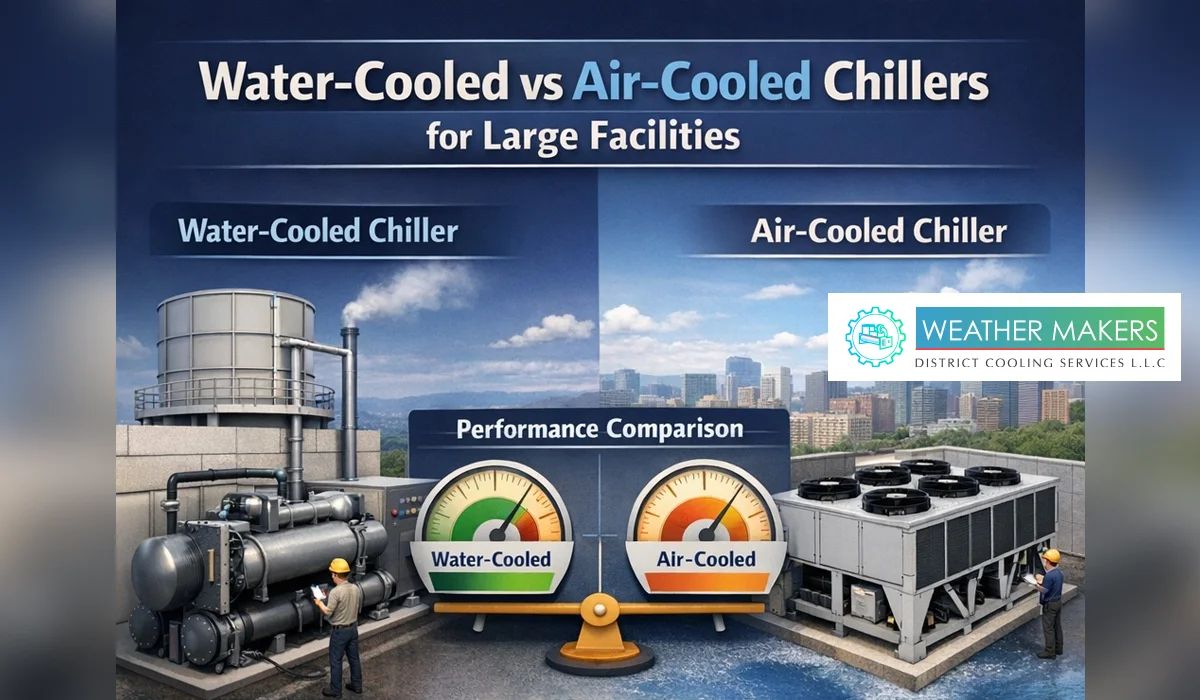
Water-cooled vs air-cooled chillers is a common comparison during the planning of large-scale cooling applications. Cooling of large buildings requires a highly efficient and consistent process to support various operations. Failure of a cooling system can increase costs and disrupt critical operations within a large facility. With this in mind, chillers must operate consistently to support operational loads.
The differences between water-cooled and air-cooled cooling methods are explained clearly and simply in this guide. The areas discussed include performance, installations, maintenance, and appropriateness. Each of these areas is explained clearly and practically.
Understanding Large-Facility Cooling Requirements
Large facilities operate under constant thermal loads. Cooling systems must perform without interruption. Downtime causes financial and operational risks.
Key factors include:
- Cooling capacity needs
- Energy efficiency expectations
- Available installation space
- Maintenance planning
- Long-term operating cost
A well-matched industrial chiller supports stable operations. A poorly selected system increases expenses and maintenance issues.
What are water-cooled chillers?
Water-cooled chillers remove heat using water circulated through a cooling tower. These systems suit high-capacity applications. They perform well in continuous-load environments.
They are commonly installed indoors. They require additional components. These include cooling towers and water treatment systems.
Key characteristics
- High energy efficiency
- Stable performance in hot climates
- Longer equipment lifespan
A commercial water chiller often relies on this design for large-scale cooling demands.
What are air-cooled chillers?
Air-cooled chillers use ambient air to reject heat. Fans move air across the condenser coils. These systems are simpler in design. They are usually installed outdoors. They need no cooling tower. Installation is faster and less complex.
Key characteristics
- Lower upfront cost
- Simple installation
- Reduced water usage
Many facilities select air-cooled chiller systems where space and water access are limited.
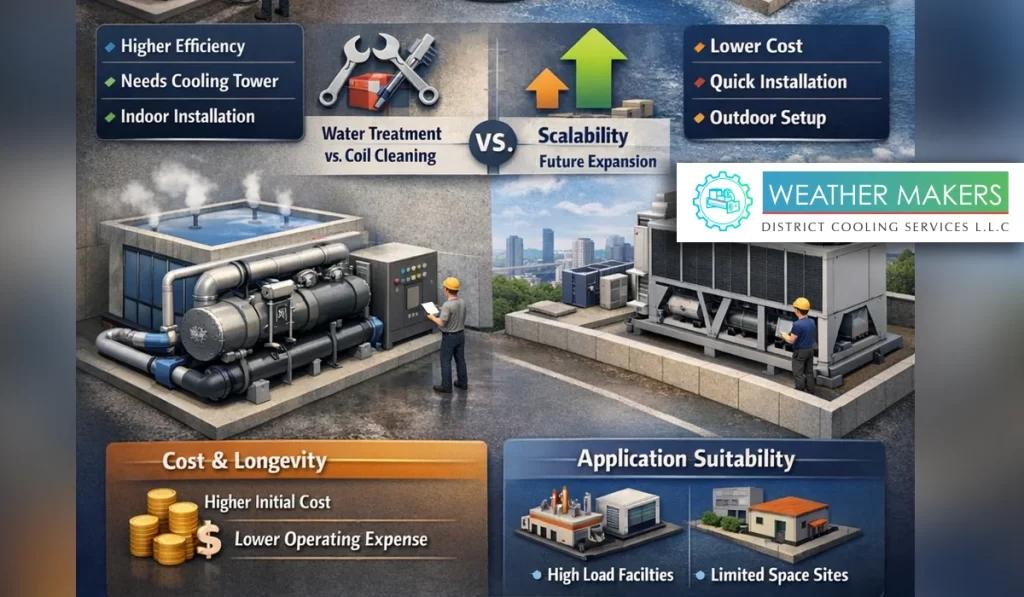
water-cooled vs air-cooled chillers: Performance Comparison
This comparison highlights how each system performs under real operating conditions.
Energy efficiency
- Water-cooled chiller systems achieve higher efficiency at large loads
- Air-cooled chiller systems consume more power during peak heat
Cooling capacity
- Water-based systems handle higher capacities
- Air-based systems suit moderate loads
Climate adaptability
- Water-based units perform consistently
- Air-based units depend on ambient temperature
This comparison shows why system selection must match usage demands.
Installation and Space Requirements
Installation conditions affect system feasibility.
Water-based systems
- Require indoor plant rooms
- Need cooling towers and piping
- Demand structured layouts
Air-based systems
- Installed outdoors
- Require clear airflow
- Need less mechanical infrastructure
Facility design often determines the practical option.
Maintenance and Operational Responsibility
Maintenance planning protects system performance. It also controls operating costs.
Chiller system maintenance differs between the two designs.
Water-cooled systems
- Regular water quality monitoring
- Cooling tower cleaning
- Pump and valve inspections
Air-cooled systems
- Coil cleaning
- Fan motor checks
- Airflow inspections
A professional chiller company ensures systems operate within safe limits.
Service and Support Considerations
Reliable support reduces downtime.
Facilities often require:
- Scheduled chiller preventive maintenance
- Emergency chiller repairing and maintenance
- Long-term chiller maintenance services
Specialized support is essential. Proper chiller maintenance protects efficiency and extends equipment life. Dedicated chiller services reduce operational risks.
Application Suitability for Commercial Facilities
Different facilities have different cooling needs. Chillers for commercial buildings must match usage patterns.
Best fit for water-cooled systems
- High-load facilities
- Continuous operation sites
- Long-term energy efficiency goals
Best fit for air-cooled systems
- Limited indoor space
- Lower capacity needs
- Faster deployment requirements
A professional water-cooled chiller service supports system longevity. A specialized air-cooled chiller service ensures stable outdoor operation.
Cost Comparison and Long-Term Value
Initial cost differs from lifetime value.
Water-based systems:
- Higher initial investment
- Lower operating costs over time
Air-based systems:
- Lower upfront cost
- Higher long-term energy use
Total cost evaluation should include maintenance, energy, and service support.
Energy Consumption and Operational Efficiency
A major aspect in the selection process concerning large facilities is the energy usage. Cooling equipment-run hours are generally extended. Even the smallest differences can significantly influence the overall costs. For facilities with high demand, the cooling energy usage needs consideration.
It should also be noted that operational efficiency does play a role in ensuring that systems remain stable as well. This is because proper cooling does help to prevent machines from wearing out due to the strains that come with the application of cooling systems.
Scalability and Future Expansion Planning
Large facilities often increase in size over time. Cooling systems would need to support an increase in size in the future. A system that scales up provides the potential to increase the capacity of the system in the future without having to replace the system completely.
Long-term value is maintained by planning to expand a system. Long-term planning helps to ensure that a system remains a high performer as operational demands change. It can also prevent a facility from being limited in terms of performance. Better asset management can thus be achieved as a result of planning to expand a system of operations.
Conclusion
The decision on the choice of each system should be made with an effective evaluation. Water-cooled vs air-cooled chillers can never be decided based on price. There were operational requirements unique to each facility.
Large structures can greatly benefit from a structured analysis process to provide a high-performing solution. Not only can a professional installation ensure proper cooling operations, but a good system can also bring efficiency and cost control to a location.
Frequently Asked Questions
What is the main difference between water-cooled vs air-cooled chillers?
In the water-based system, the medium of heat rejection is normally water, while the air-based system utilizes air.
Why is chiller preventive maintenance important?
It reduces breakdown risks and maintains system efficiency. Regular maintenance extends equipment lifespan.
When should chiller maintenance services be scheduled?
They should be scheduled periodically based on load and usage. Preventive servicing avoids costly repairs.