
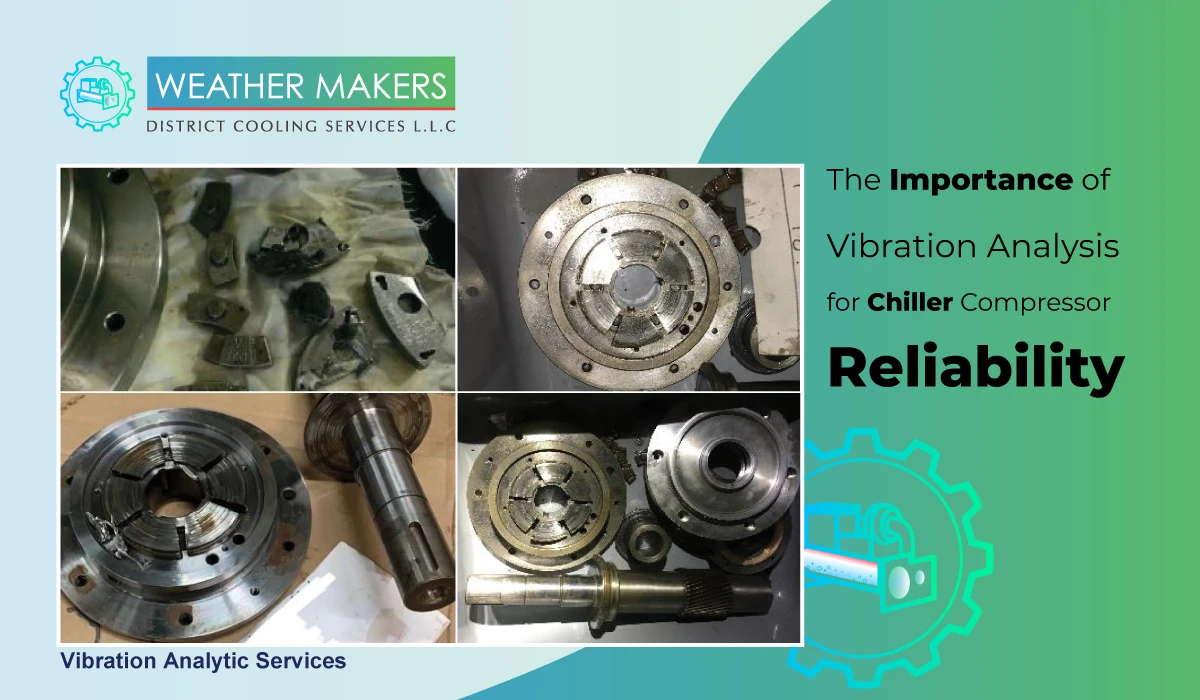
A Chiller compressor plays a vital role in the overall performance of HVAC systems and if it fails the whole cooling operation is affected. This leads to costs associated with repair, delays with unexpected downtime, and the overall operating efficiency. To combat these with the compressor performing failure analysis, vibration analysis is one of the more effective and reliable methods used today in terms of cost, and reliability. It has been an effective method for detecting equipment health and compressor reliability in various applications.
The only method of diagnosing the health of the internal moving parts of a compressor is vibration analysis. This aids in the detection of hidden mechanical problems before they can develop into catastrophic failure. While facility managers and technicians are facing pressure for greater efficiency and lower operating costs, vibration analysis is being utilized as a predictive maintenance technique.
Why Vibration Analysis is Critical in Chiller Compressor Maintenance
Each piece of rotating equipment has a designated vibration pattern while in operation, and the HVAC compressor has its own. That pattern doesn’t change while equipment is in prime working order. When that vibration pattern does change, it’s due to an imbalance, looseness, or wear on the internal components of the equipment. If internal elements are looked for differences and verified for a similar baseline, a technician can identify the location, origin, and extent of an issue before it even begins.
Most Significant Chiller Compressor Vibration Analysis Benefits
Pre-Mechanical Fault Identification
A few of the most critical vibration analysis benefits are:
It can identify incipient faults such as:
- Wearing in bearings
- Imbalance of a shaft
- Rotor misalignment
- Loose parts
- Screw compressor rotor tolerance problems
Early identification of these issues is making it possible to schedule repairs at the right time, reducing the likelihood of premature failure. This is not only prolonging the compressor’s lifespan, it is keeping the cooling system at peak levels of performance.
Increased Compressor Reliability
As soon as vibration analysis is carried out on a regular basis, it ensures that faults are repaired at their initial stages. Repairing faults early before they get very critical significantly enhances overall compressor reliability. This saves time, frees money from unnecessary emergency repairs, and provides facility operators with peace of mind.
Cost Savings and Risk Reduction
Running a HVAC compressor to failure normally results in expensive repairs, lost production, and wasted energy. With this analysis, businesses can transition from a “run to failure” procedure to predictive maintenance. With predictive maintenance, businesses minimize repair expense, decrease operating risk, and reduce overall maintenance spend.
Increased Mean Time Between Failures (MTBF)
Mean Time Between Failures is an important indicator of the reliability and health of the equipment. Vibration analysis helps in increasing MTBF by directly picking up minor faults before they turn into costly breakdowns. With vibration monitoring, the compressor of the chiller can operate for a longer period without being shut off.
How Vibration Analysis Works
By making use of vibration-measuring software and sensors, vibration analysis measures the amount of vibration in an operating compressor. Sensors track the vibrations along frequency, amplitude and phase. Each component of the compressor – bearings, rotors and shafts – possesses its own vibration signature.
This facilitates technicians to identify faults via vibration signatures such as:
- High frequency could indicate bearing damage
- Misalignment of the shaft can be marked by low frequency
- Vibration patterns outside of normal can signal looseness or balance of components.
With this amount of accuracy observation, technicians are able to correct issues before it leads to a chain reaction of failures.
Shifting From Reactive to Predictive Maintenance
The majority of service industry maintains a policy of reactive maintenance, i.e., they only serviced the compressor of the chiller after it had broken down. Although it is cost saving in the short term, it will prove to be more costly in the long term because of emergency breakdowns and unplanned down time.
Vibration analysis is a predictive maintenance technique. Through the analysis, chiller maintenance and services in UAE teams are able to repair and replace at your convenience. Instead of waiting for the compressor to break down, you will be in a position to repair issues before time so that the systems are maximized in efficiency every moment.
Practical Benefits of Vibration Monitoring
Analysis has virtually eliminated surprise failures of chillers in many plants in the real world. Some examples are as follows:
- Detection of bearing wear has provided advance notice to prevent complete motor destruction.
- Detection of rotor misalignment prevented costly teardown and overhaul of the entire compressor assembly.
- Monitoring a screw compressor’s rotor tolerance is an efficient way to save energy.
The result is greatly minimized repair cost, and an unwavering vigilance operation to avoid any disturbance to its cooling functions. This uptime is invaluable to health care facilities, data centers, and other industrial processes.
Steps for Effective Vibration Analysis
- Continuous Monitoring – Make provisions for regular vibration monitoring to always monitor compressor health.
- Trained Teams – Have only the analysis performed by trained teams that know vibration signatures well.
- Compare Data – Keep a record of vibration signatures. This enables the smallest changes to be detected.
- Act With Relevance – Upon finding an anomaly, take action to address the issue promptly.
If these steps are carried out, the result is an intelligent maintenance program that ensures any HVAC compressor is operating to its optimal levels.
Conclusion
A chiller compressor is the heart of the cooling system, and compressor reliability has a direct impact on system efficiency, energy bill, and operating cost. Component vibration monitoring on a periodic basis offers an effortless and efficient way to detect concealed problems and ensure long-term compressor reliability. With a shift from reactive repair to predictive maintenance, facility managers can reduce downtime, lower costs, and extend equipment life.
In the current cost-sensitive environment, where cost and reliability are the optimal priorities, vibration analysis remains one of the optimal methods of cooling compressor maintenance at its optimum.
Frequently Asked Questions
Why is vibration analysis the best for improving chiller compressor reliability?
Vibration analysis picks up on hidden faults in good time, and can therefore be maintained in good time and compressor reliability will be improved.
Does vibration analysis cure all types of compressor problems?
It is highly effective in imbalance, misalignment, looseness, and bearing wear detection, though other types of tests are used in full diagnosis.
Why is vibration analysis so important in a HVAC compressor?
It keeps the HVAC compressor healthy, prevents downtime, and ensures efficient operation over the long term.