
Chiller operation relies on scientific principles that ensure the cooling process works effectively to keep buildings, industries, and machines cool. To learn how a chiller works, there is a need to understand the aspects of thermodynamics and the basics of refrigeration cycles. These two aspects help in understanding how heat works and how chillers maintain temperatures.
Understanding Thermodynamics in Cooling Systems
Thermodynamics covers how heat can transfer from one location to another. The chiller applies the above rules to absorb heat from water or from the air to release the heat at another location.
These are some fundamental thermodynamic principles that all cooling systems must follow:
- Heat always flows from hotter areas towards cooler area.
- Heat can alter the state of matter, such as when a liquid changes to a gas.
- Energy can take various forms; it cannot be destroyed.
- Pressure rises when the temperature rises.
- When pressure drops, the temperature drops.
Chillers follow these basic rules to manage temperatures. They manage temperatures through refrigerants, compressors, and heat exchangers.
How Thermodynamics Propels Heat Transfer
A chiller absorbs heat through a controlled cycle. The controlled cycle always follows the laws of thermodynamics.
These are the basics:
- It absorbs heat from the cold water.
- It changes from liquid to gas as it absorbs heat.
- The compressor raises the pressure of the gas.
- Pressure raises the temperature.
- It gives out heat to the airflow or water.
- The refrigerant cools and reverts to a liquid.
- The expansion device reduces the pressure further.
The refrigerant will be chilled and ready for the next cycle. These processes occur continuously, allowing the chiller to maintain a stable and uninterrupted cooling cycle.
Critical Parameters in the Refrigeration Cycle
All chillers have the basic components. The components function together to transfer the heat. These are the components and their basic functions:
• Compressor
- Attracts low-pressure gas of the refrigerant.
- It compresses the gas under high pressure.
- Increases the temperature of the refrigerant.
• Condenser
- Transfers heat from the high-pressure gas.
- It converts gas to liquid.
- Transfers heat from the system.
• Expansion Valve
- Decreases refrigerant pressure.
- It makes the refrigerant cold again.
- Regulates the flow of the refrigerant.
• Evaporator
- It absorbs heat from the chilled water.
- Enables the substance to change from liquid to gas.
- Return the refrigerant gas to the compressor.
All these parts ensure the repetition of the process in order to maintain the necessary temperature in the water.
Types of Refrigeration Cycles
Various chillers operate using different cycles. Each cycle has its own function and consumption of energy. Here are the most frequent cycles:
1. Vapor Compression Cycle
It is the most popular cycle. It operates in four stages:
- Evaporation
- Compression
- Condensation
- Expansion
It can be found in small and large chillers. It has good cooling capacity.
2. Absorption Refrigeration Cycle
The process utilizes heat rather than compression.
To summarize:
Uses absorbent solutions.
- Common in locations where waste heat can be obtained.
- Much quieter and employs fewer moving parts.
- Energy consumption varies with the heat source.
3. Magnetic Refrigeration Cycle
It is considered a relatively new technology.
Key features:
- Uses magnetic fields rather than refrigerants.
- Very efficient.
- No harmful chemical refrigerants.
- Still under development for large equipment.
“Heat Transfer” Expressed Simply
Heat transfer is the backbone of chiller performance. It determines the speed and effectiveness of heat removal in the chiller. In every chiller, there are two different categories of heat exchangers. They are:
Plate Heat Exchanger
- Thin plates stacked together.
- High heat transfer rate.
Shell & Tube Heat Exchanger
- The tubes are in the large shell.
- Very strong and reliable.
- Common in industrial chillers.
In both cases, the refrigerant and water do not mingle at all. They transfer heat through the metals.
Pressure and Temperature Correlation
Pressure and Temperature vary in tandem.
When pressure increases:
- The temperature rises.
- The refrigerator heats up.
- Heat dissipates from the system quickly in the condenser.
When pressure decreases:
- Temperature decreases.
- Refrigerant cooling begins.
- Heat in the refrigerant enters readily in the evaporator.
This enables chillers to function efficiently.
How Thermodynamics Governs Chiller Operation
Thermodynamics affects the operation of chillers directly. Each stage relies on changes in pressure, changes in temperature, and heat transfer. There is a cycle involving the compressor, the condenser, the evaporator, and the expansion valve. Each stage regulates the transfer of energy. It is therefore clear that chillers function effectively when all the stages adhere to thermodynamics. Otherwise, the cooling capacity decreases.
Refrigerants: The Working Fluid in Refrigeration
Refrigerants are essential in such a cycle. They transport heat from one location to another.
- These are essential facts about refrigerants:
- Boil at low temperatures.
- Easily shift between liquid and gas.
- Absorb and release heat efficiently.
- Should be environmentally safe.
- Must match the chiller’s design and operating requirements.
Most modern refrigerants have a low environmental impact. This makes chillers more environmentally friendly.
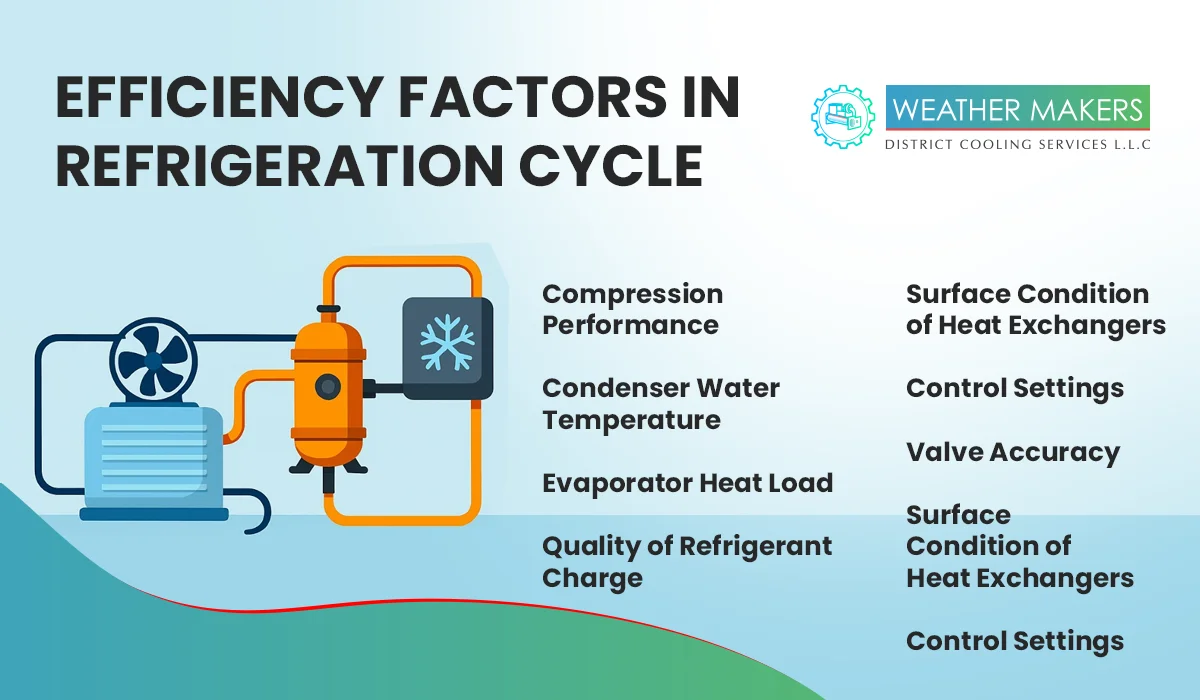
Efficiency Factors in Refrigeration Cycles
There are several factors that influence the efficiency of the chiller.
These are the most important ones:
- Compression performance
- Condenser water temperature
- Evaporator heat load
- Quality of Refrigerant Charge
- Surface condition of heat exchangers
- Control settings
- Valve accuracy
If these factors are maintained in balance, the chiller ensures proper cooling with less consumption of power. Regular chiller maintenance services ensure these factors are checked and performance remains optimal.
Typical Thermodynamic Problems in Chillers
Chillers experience several common issues related to thermodynamic imbalances.
These include:
- Inadequate heat transfer
- Low refrigerant charge
- High pressure in the condenser
- Fouled Heat Exchangers
- Excess heat load
- Inefficiency in the compressor
These factors affect performance. Routine verification helps to eliminate failure. A chiller maintenance company can support performance and prevent breakdowns. Scheduled inspections protect components and extend lifespan.
Importance of Understanding Refrigeration Science
Knowing how the cooling cycle works helps with:
- Improving System Designs
- Enhance Maintenance Planning
- Quick troubleshooting
- Lower Energy Consumption
- Longer equipment lifespan
- Excellent cooling performance
A stable chiller operates consistently. It becomes easier to maintain its reliability when the scientific principle underpinning it can be fully comprehended.
Conclusion
The scientific aspects of the cooling process in chillers can easily be understood. The scientific principle involved in the functioning of chillers revolves around thermodynamics and the cooling cycle. Cooling cycles are essentially based on the process of moving heat from one point to another using the process of refrigeration, pressure, and heat transfer. All these components combined make the process of chilling robust when working in harmony. By knowing the scientific aspects, efficiency can easily be increased.
Frequently Asked Questions
What is a refrigeration cycle?
“Refrigeration cycle” refers to the process by which the refrigerant absorbs heat and then releases it outside. It is an ongoing process in order to get cooling.
Role of thermodynamics in chiller operation?
It regulates the transfer of heat and the variation in pressure. These rules make it possible for the chiller to cool water.
Significance of Refrigerant in a Chiller?
Refrigerant transports heat. It changes from liquid to gas and vice versa in order to transport heat from source to source.