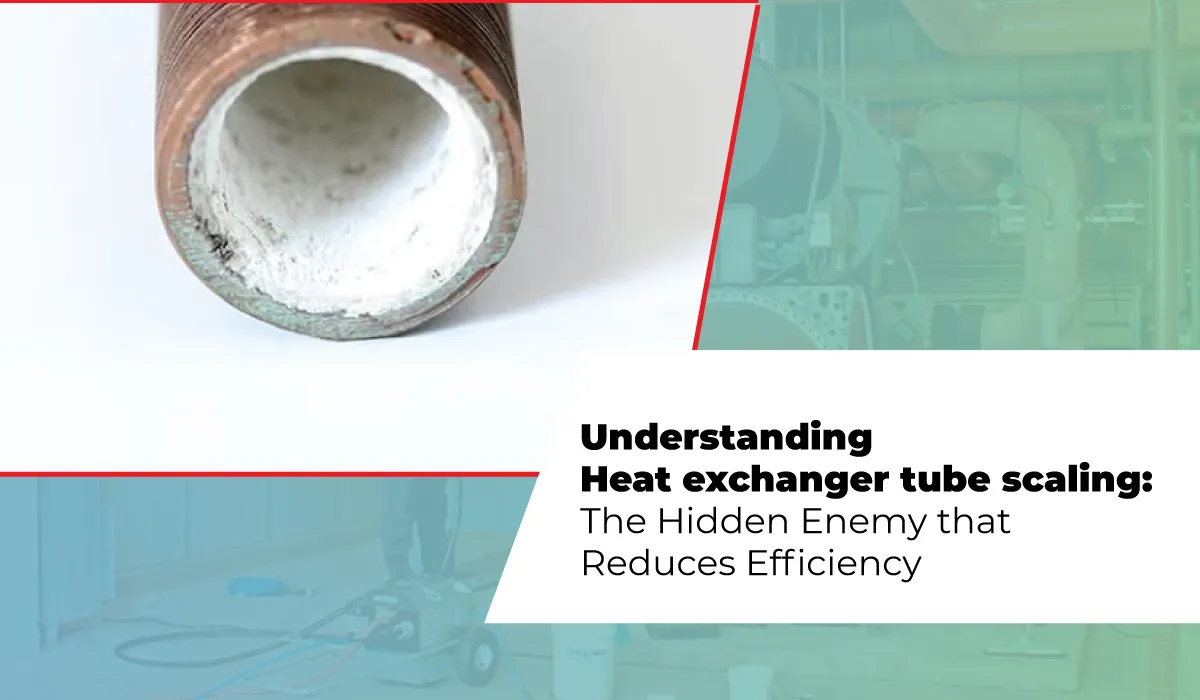
Tube Scaling ( fouling ) is a highly prevalent and hazardous issue detected on heating and cooling devices in business and commercial buildings. Calcium and magnesium minerals in water over time create hard deposits on metal surfaces of boilers, chillers, heat exchangers, and cooling towers. Deposits reduce the heat transfer, raise energy usage, and lower equipment life.
You can prevent expensive downtime and prolong the lifespan of your system if you detect the symptoms of limescale buildup in your HVAC system early. Let’s look deeper into the serious effects of limescale on your system, how to identify it, and what you can do to keep your HVAC system running smoothly.
4 Major Signs You Have an HVAC Scaling Problem
Limescale does not build up overnight; it builds up slowly. If deposits do accumulate, the system will start to exhibit subtle indications of distress. Prompt identification of the symptoms will avoid catastrophic failure and expensive repairs.
1. Higher Operating Costs
One of the first warning signs that HVAC scale buildup is happening is an observable increase in operating costs. The more scale that forms on heat transfer surfaces, the harder your system must work to provide the same amount of cooling or heating. That extra work burns more electricity, increasing your energy bills.
If the energy usage in your facility continues to rise when operating time is unaltered, the likely cause is limescale buildup. Scaling as slight as 1/16 inch on boilers and chillers can add up to energy usage by as much as 11 percent, plumbing engineering research shows. Pumps and compressors must labor harder, cause extra wear and tear, and add maintenance expenses.
2. Equipment Down-Time Rise
If limescale is allowed to build up in critical HVAC equipment, it can cause complete or periodic shutdowns. It typically requires equipment shutdown and an intensive deposit removal process, which causes downtime and lost production.
Preventive maintenance must be done to prevent such breakdowns. Facility managers must stick to routine cleaning procedures and see to it that there is a check of scale buildup on each service call. Not detecting signs early may result in catastrophic failure, and such failures may take days or weeks to restore.
3. Higher Heating and Cooling Energy Usage
An ongoing rise in heating or cooling energy costs will also indicate limescale in your system. Even small deposits decrease the efficiency of heat transfer, so your system will have to run longer to achieve the same temperature.
Building managers closely monitor energy costs so they can be included in their operations budget. When energy use continues to climb while having consistent usage patterns and weather conditions, it is time to examine the HVAC system for scaling.
4. Reduced Equipment Efficiency
Limescale reduces the chiller, heat exchanger, boiler, and cooling tower efficiencies. You can observe effects in the form of high head pressures, abnormal pump readings, or low temperature differentials around the system.
Ongoing measurements of pressure levels and flow rates show performance changes that will be related to scale. Where equipment performance is not boosted by maintenance, limescale will hinder heat exchange surfaces from operating or slow down the flow of fluids.
The True Cost of HVAC Limescale
Limescale doesn’t just ruin performance—it affects the bottom line. A low-scale deposit by itself can drive up fuel and electricity expenses, place mechanical equipment under stress, and reduce the lifespan of expensive equipment.
Some of the economic effects are:
- Up to 11% increased energy consumption with just a 1/16-inch scale deposit.
- Increased failure rate of pumps, compressors, and heat exchangers.
- Increased consumption of chemicals and detergents to keep water hardness.
These all add up over time and impact the profitability and efficiency of building operations as a whole.
Preventing HVAC tube Scaling Deposits
Prevention of limescale is a matter of water treatment and maintenance. Depending on the type of system and water quality, chemical and mechanical methods are used to control or eliminate scale deposits.
1. Chemical Descaling
Chemical descalers are chemical liquids that are specially designed to dissolve mineral deposits and calcium carbonate in HVAC systems. Chemical descalers chemically dissolve the scale, which dissolves so it can drain from the system without causing damage. Chemical cleaning is exceptionally good at regaining efficiency in hard water cases.
But chemical treatment must be done carefully so that it does not harm the parts of the systems. Normal inspection and professional advice guarantee protection and efficiency in cleaning.
2. Mechanical Cleaning
Mechanical descaling is a process in which equipment, such as rotary tube cleaners or projectiles, is used to descale mineral deposits from the equipment surface by mechanical action. It is mainly used in chillers, boilers, and heat exchangers with excessive deposits in tubes or coils.
Mechanical cleaning is usually done by a chiller service company with equipment that can access areas of the system that are not accessible. It ensures scale removal and restoration of water flow and heat transfer efficiency to its optimal condition.
3. Water Treatment Programs
Water pre-treatment offers the longest duration of protection to the HVAC scale. By studying the chemistry of the water source, treatment experts can develop a tailored treatment regimen that reduces scale formation.
They use dosing systems, softening, or filtration systems to preserve the mineral content of water in a stable condition. They need frequent testing and maintenance to produce output consistently. Daily inspection is still needed even after water treatment, since no system can totally prevent scale deposition.
Why Routine Maintenance is Needed
Failure to service HVAC equipment is one of the primary reasons limescale situations become irreversible. Having the ability to speed-dial well-established HVAC maintenance companies ensures that your equipment gets frequent inspections, cleaning, and a depreciation assessment of its performance.
A reputable chiller service company will not only scale the limescale that is already present, but also move forward to take measures so that it will not form again in the future. Maintenance is cost-saving with the life of high-cost equipment, less energy consumption, and avoiding premature downtime.
Conclusion
HVAC limescale is an insidious but extremely damaging issue that reduces performance,increases energy consumption, and shortens equipment life. Descale regularly, have experts inspect your system, and properly treat the water to maintain your HVAC at optimal performance.
A commercial chiller service firm can assist in removing all equipment, such as chillers and heat exchangers, from scales. Taking timely action can protect your investment, lower operating costs, and extend equipment life.
Frequently Asked Questions
Why does HVAC limescale occur?
It occurs because calcium and magnesium minerals in water precipitate hard deposits on HVAC equipment heat transfer surfaces.
How often do I need to clean my HVAC system to prevent limescale?
Cleaning should be performed at least once a year, but it is dependent on the type of system and water hardness.
Can an HVAC tube scaling be completely removed by a chiller service technician?
Actually, a professional chiller service technician uses mechanical or chemical descaling to eliminate HVAC scale and return system efficiency to a high level.