Air-cooled chillers are a major part of modern cooling systems. These chillers have numerous applications in regions where access to water is limited. Such chillers are recognized for their compact design. They remain widely used across many applications for temperature control.
The demand for cooling continues to increase across various sectors. Selecting the right equipment is critical for efficient operation. Air-based technologies provide ease of installation with flexibility.
In these chillers, the heat rejection occurs directly to the surrounding atmosphere. Cooling towers are not required. This reduces infrastructure dependency and improves space efficiency.
Basic Concept and System Operation
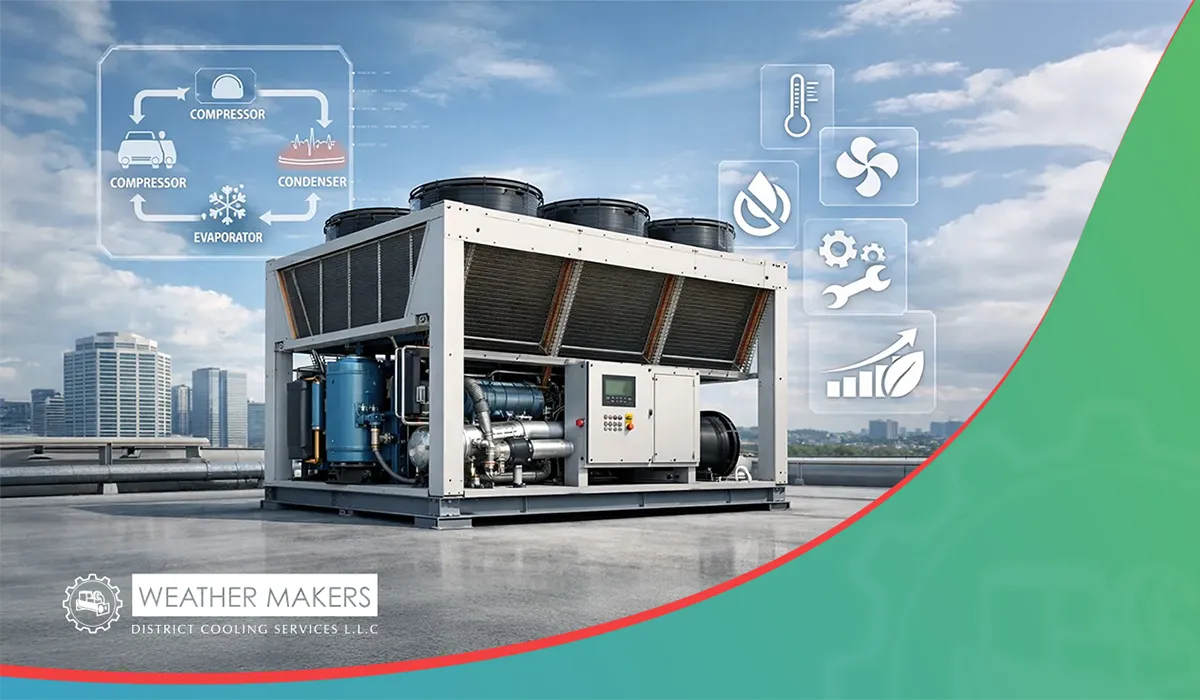
This understanding supports accurate system selection and correct operation. The system operates on a closed refrigeration cycle, ensuring consistent and controlled cooling performance. The air-cooled chiller working principle depends on the heat absorption and rejection. The refrigerant absorbs heat from the fluid. The refrigerant gives out the heat through the use of condenser coils and air.
The cycle operates continuously, and fans support the heat rejection process. Compressors control pressure and temperature. Controls oversee system operation and ensure safety.
Important Design Factors
System design has an impact on performance and reliability. Effective planning allows for efficient performance and increased system life. System designers take into consideration loads and environmental conditions.
The air-cooled chiller design principles highlight airflow, heat transfer, and system integration. The position of the equipment is equally important. Proper spacing enhances convective heat transfer.
Critical design considerations include:
- Cooling capacity demands
- Ambient temperature range
- Noise limitations
- Power availability
- Maintenance access
These affect operating costs over a long period.
Main System Components
In each unit, there are a number of essential components. These components operate together to maintain consistent cooling performance. Understanding these components supports effective maintenance and repair.
The air-cooled chiller system components may consist of:
- Compressors for refrigerant distribution
- Condenser coils for heat rejection
- Evaporators for heat absorption
- Axial or centrifugal fans
- Expansion devices
- Control panels and sensors
Each element has to harmonize and function properly. A failure in one area impacts the whole process.
Performance Advantage of Air-cooled Chillers
Air-cooled chiller systems offer several operational benefits. These are the reasons why such systems are widely used. They also save infrastructure.
Key benefits:
- No cooling tower needed
- Reduced water usage
- Simple installation
- Less system complexity
- Relocation could be easier if required
This allows faster project implementation.
Applications across Sectors
Cooling applications also differ by industry. Chillers are used for various applications. They can cool for both comfort and processes. They can be used as an air-cooled chiller for HVAC systems. Office buildings rely on them for a stable indoor climate, while data facilities use them for equipment cooling.
They are also used as chillers for commercial buildings. They are used in shopping centers for large open areas. Healthcare centers require a stable temperature environment. They are also used by industrial plants for process cooling. This includes manufacturing and packaging operations.
Limitations and Operating Challenges
Like any cooling system, certain limitations must be considered during selection. The performance may be affected by outside factors.
Higher ambient temperatures might impact efficiency. Restrictions in airflow might influence heat rejection. Noise levels might need noise-reduction strategies. Energy consumption may increase during peak operating conditions. Space allocation is a more significant consideration in highly dense installations.
Maintenance and Reliability Requirements
Routine maintenance is essential. Poor maintenance increases the risk of system failure. Regular chiller system maintenance makes the system more reliable. This minimizes unplanned shutdowns. Regular maintenance also helps to protect the system’s components.
Typical maintenance activities include:
- Coil cleaning
- Fan inspection
- Refrigerant level checks
- Electrical connection testing
- Control calibration
Professional support results in a positive impact.
The Significance of Preventive Maintenance
Proactive care enhances the lifespan of equipment. This intervention avoids expensive machine failures. In addition to that, it aids in energy efficiency. A planned chiller preventive maintenance program will minimize emergency repairs. It can point out potential problems early. Thus, it results in saving operational costs in the long run.
Many companies have a reliable chiller company for regular inspections. Professional technicians operate under the manufacturer’s guidance. They check for safety regulation compliance.
Repair and Service Support
Even properly maintained equipment may need repairs. Early intervention prevents downtime. Expert help is needed. Technical chiller repairing and maintenance services cater to mechanical and electrical failures. This ensures a speedy return to functionality. Part availability enables faster system recovery.
Full chiller maintenance services may include analysis and reports. It assists with planning for a possible future replacement or upgrade. It also helps with managing assets.
Consideration for the Environment and Energy
Energy saving is still an important issue. Only optimized designs are preferred now. This lowers emissions. Advanced control systems regulate compressor performance. The variable-speed fans control the airflow. These enhancements provide better part-load efficiencies.
Correct handling and maintenance promote environmentally favorable performance. This helps ensure that sustainability and cooling requirements are met.
Conclusion
System selection also involves technical knowledge. The operating environment has to be scrutinized. Maintenance facilities should also be obtained early. Air-cooled chillers are still a viable option. This is due to cooling, installation, and flexibility being effectively balanced. If well designed and maintained, they can serve for a number of years.
Frequently Asked Questions
In what ways do air cooled chillers differ from water-based systems?
In air-cooled chillers, heat is rejected by using the ambient air and does not incorporate cooling towers.
Why is regular chiller system maintenance important?
It prevents system overheating and reduces the risk of component failure.
Which industries commonly employ chillers for commercial buildings?
These are widely used in office spaces, retail stores, healthcare facilities, and data centers.