Cooling tower water conservation is currently receiving increased attention from various industries. Utility rates, especially those for water, continue rising. In addition, the environment becomes an ever-growing issue. As a result, businesses are making great efforts to conserve water usage across their heating, ventilating, and air conditioning systems. Since cooling towers require huge amounts of water for their daily operation, it is necessary to save as much water as possible to maintain efficient operation.
Reasons Behind the Importance of Cooling Tower Water Conservation
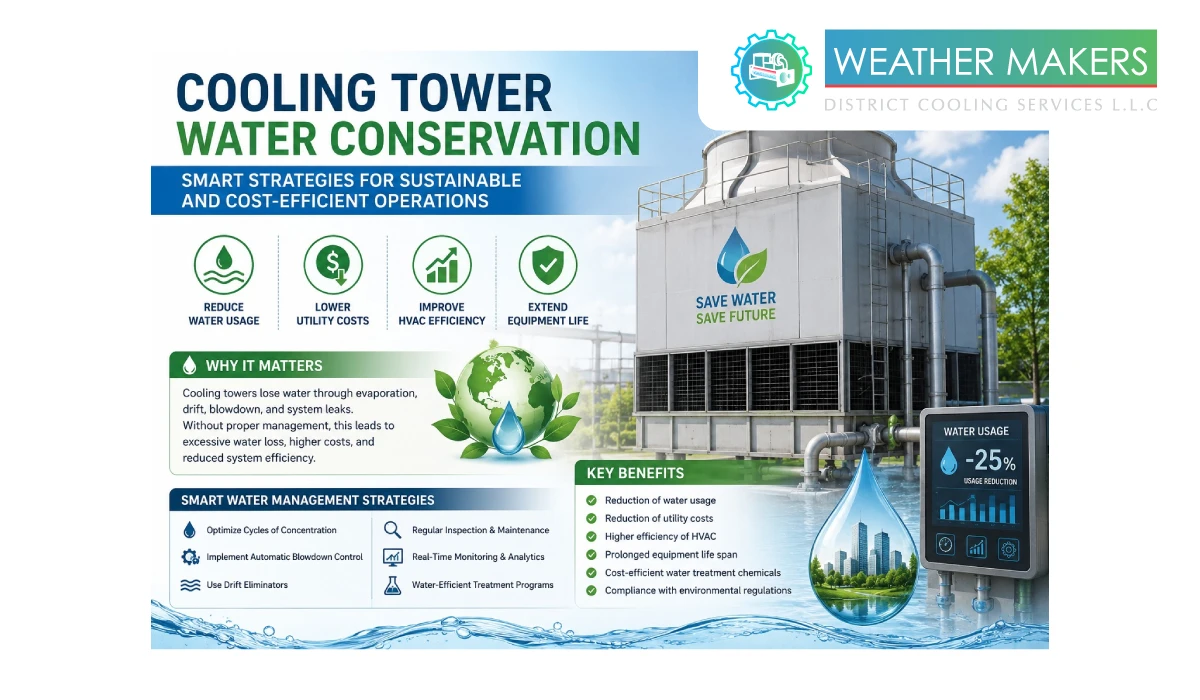
During the cooling process, evaporation occurs, leading to water loss. Additional water loss takes place due to drifts, blowdown, and various system leaks. Therefore, the lack of proper management can lead to excessive water loss.
Many companies nowadays realize that apart from protecting the environment, water saving can help cut costs and increase system efficiency. Appropriate water-saving techniques ensure operational stability.
Advantages of smart cooling towers’ water management include the following:
- Reduction of water usage;
- Reduction of utility costs;
- Higher efficiency of HVAC;
- Prolonged equipment life span.
- Cost-efficient water treatment chemicals;
- Compliance with environmental regulations.
Main Causes of Water Waste in Cooling Towers
Overuse of Blowdowns
Blowdowns are used to eliminate dissolved solids from the water. Nevertheless, excessive blowdown frequency often results in the waste of huge amounts of water.
Leaks and Mechanical Issues
Although small leaks may seem insignificant, they still cause considerable water losses over the period of several years. Mechanical issues include valve failures, cracked pipes, etc.
Poor Water Quality Management
Improper treatment leads to such problems as scaling, corrosion, or biological contamination. Such problems decrease the efficiency of the system, resulting in high water waste.
Drift Losses
Inevitable losses occur due to the fact that some water particles escape with the airflow. Ineffective drift eliminators contribute to the water waste.
Digital Monitoring Tools Reduce Water Waste
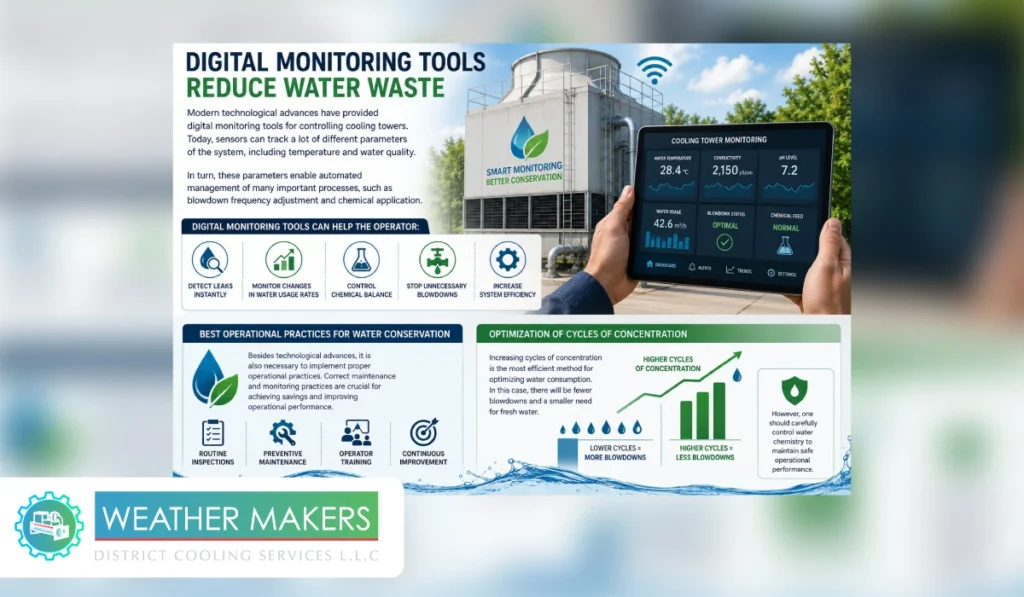
Modern technological advances have provided digital monitoring tools for controlling cooling towers. Today, sensors can track a lot of different parameters of the system, including temperature and water quality.
In turn, these parameters enable automated management of many important processes, such as blowdown frequency adjustment and chemical application.
Digital monitoring tools can help the operator do the following:
- Detect leaks instantly;
- Monitor changes in water usage rates.
- Control chemical balance;
- Stop unnecessary blowdowns;
- Increase system efficiency.
Best Operational Practices for Water Conservation
Besides technological advances, it is also necessary to implement proper operational practices. Correct maintenance and monitoring practices are crucial for achieving savings and improving operational performance.
Optimization of Cycles of Concentration
Increasing cycles of concentration is the most efficient method for optimizing water consumption. In this case, there will be fewer blowdowns and a smaller need for fresh water.
However, one should carefully control water chemistry to maintain safe operational performance.
Routine Inspection of Cooling Towers
Regular inspection is a very important measure for avoiding water waste. By inspecting the system, an operator can detect leaks, mechanical problems, or improper water use rate.
An inspection should include the following components:
- Pipe connections;
- Valves and pumps;
- Drift eliminators;
- Water distribution system;
- Basin conditions.
Improvement of Water Treatment Programs
The quality of water treatment affects the efficiency of the system negatively. Thus, it is essential to develop proper treatment procedures for minimizing scaling and corrosion. Moreover, chemical management can help prevent biological contamination of the system.
Upgrade Old System Components
Older cooling towers tend to operate improperly due to out-of-date technological solutions. Newer systems usually have built-in mechanisms of water conservation. Thus, upgrading old towers is an appropriate solution. Possible upgrades include:
- High-efficiency drift eliminators;
- Variable speed drives;
- Automatic controllers;
- Smart sensors;
- Advanced filtration systems.
The Benefits of Automating Systems to Save Water
Another important tool that can minimize water waste is automation. With automated systems, it is possible to monitor and adjust operational conditions constantly. Automated controllers eliminate the need for constant manual adjustments. Thus, system operation can be stabilized easily.
Some of the benefits of automation include:
- Reduction of water waste;
- Reduction of energy consumption;
- Higher reliability;
- Faster detection of problems;
- Increased operational stability.
Also, automation ensures compliance with sustainability objectives.
Effective Strategies for Reusing Water
There are also a number of approaches for reusing water. Some types of water that have already been utilized can be recycled for other purposes. Thus, recycling can be successfully applied in cooling towers.
There are some popular options for water recycling:
Greywater Utilization
Properly treated greywater can be reused as cooling tower make-up water.
Condensate Recovery
Such systems collect condensate from air conditioning systems. Collected water can be used in the same manner as greywater.
Rainwater Collection
Rainwater collection systems provide an extra supply of make-up water.
Enhancing Cooling Tower Operation Through Maintenance
One of the main ways of improving cooling tower water efficiency is maintenance. Poorly serviced cooling towers operate inadequately and consume too much water. Therefore, a proper maintenance program is crucial.
In this case, one should pay attention to preventive service. As a result, there will be fewer failures and problems, as well as less water consumption.
Among the most important maintenance operations, there are the following activities:
- Cleaning of tower basins;
- Nozzle cleaning;
- Drift eliminator inspection;
- Water chemistry checking;
- Sensor checking;
- Pump and motor checking.
Proper maintenance helps prolong system lifespan and avoid failures.
Technological Solutions Supporting Water Saving
Various new technological solutions also contribute to the efficient performance of cooling towers and water savings.
Side-Stream Filtration
Filtration systems eliminate solid contaminants from water, increasing its efficiency.
Smart Water Meters
Such meters measure water usage continuously. Moreover, they allow detecting abnormal usage rates promptly.
Hybrid Cooling Systems
Some cooling towers incorporate both dry and wet cooling systems. Depending on the specific operating conditions, one can change the cooling system accordingly.
Artificial Intelligence-Based Analytics
AI-based software is capable of analyzing data from sensors and identifying water-saving opportunities.
Water Saving Approaches for Achieving Long-Term Objectives
In order to attain long-term sustainability, it is necessary to implement an efficient approach. Thus, the combination of maintenance, automation, staff training, and system upgrades is key to success. Typically, successful programs include the following activities:
- Regular audits
- Tracking of water usage rate
- Training programs
- Preventive maintenance plan
- Performance benchmarking
- Program improvement
Ensuring Reliable Operation through Proper Chiller Service
Cooling towers are a part of HVAC systems alongside other devices like chillers. If the latter operates poorly, then the cooling tower will suffer. Therefore, it is necessary to service and inspect chillers regularly.
Many Chiller maintenance companies can help businesses perform routine maintenance. Companies searching for chiller repair in Dubai usually try to avoid downtime of the cooling process.
Preventive maintenance programs like chiller maintenance Dubai services can help ensure the reliable performance of a system. When an emergency occurs, a business needs to find a chiller repair near me. Inspections carried out by a chiller service near me organization will also help improve cooling towers’ performance.
Practical Approaches to Water Saving
It is quite possible to significantly reduce water losses with the proper utilization of various techniques. Although some of them are simple, they still bring good results.
The list of useful Cooling tower water saving techniques includes the following measures:
- Installation of automatic blowdowns
- Prompt repairing of leaks
- Application of high-efficiency drift eliminators
- Water reuse
- Filtration system improvement
- Frequent water testing
- Regular system inspection
Effective Water Saving Requires an Integrated Strategy
Modern solutions include both technological innovations and operational practices. Delaying implementation of such measures results in inefficiency and excessive spending. Therefore, many companies decide to apply some of the available industrial water conservation solutions. They include the following:
- Energy-efficient designs
- Water-saving devices
- Water treatment technologies
- Leak detection tools
- Advanced insulation materials
- Recycling systems
Effective water conservation in cooling towers helps businesses achieve sustainable development and minimize costs. Proper maintenance increases the efficiency of chillers and provides stable operation of cooling towers. Companies often contact a Water chiller maintenance company in Dubai to perform inspections and tests.
Conclusion
Cooling tower water conservation is an unavoidable element of the efficient management of a cooling tower. Modern technological advancements provide many solutions that enable efficient water savings. With proper operational management, a cooling tower will function properly, saving water, energy, and money. Companies focused on applying modern cooling tower water management techniques will be ready for future challenges.
Weather makers district cooling services help businesses improve cooling tower efficiency, reduce water waste, and support sustainable HVAC operations.
Frequently Asked Questions
Why is cooling tower water conservation important?
Efficient water management saves water and energy while prolonging the operational life of equipment.
How often should cooling towers be inspected?
Inspection of cooling towers should take place frequently in order to detect any issues.
How does Cooling Tower Water Conservation improve system performance?
By managing water usage rates, one increases efficiency and minimizes waste.