Predictive Maintenance of Chillers plays a very important role in making sure that heating, ventilation, and air conditioning systems work properly. Similar to how regular medical check-ups are essential for health, HVAC systems also require timely inspections to avoid hidden damage that may lead to sudden breakdowns. One of the most reliable and advanced methods used today is Eddy Current Technology, which helps in detecting problems inside the tubes of heat exchangers before they become serious.
Application of Tube-in-Shell Heat Exchangers in Chiller Systems
Core to your chiller is the tube-in-shell heat exchanger. It is a device meant for heat transmission between both sides in order for it to function smoothly either for cooling or heating. The exchanger consists of several hundreds of copper tubes which employ a sophisticated technology profile in a bid to ensure maximum heat transmission efficiency.
These are continually vulnerable to chemical corrosion and constant mechanical stress. These tubes over a period can remain in silent deterioration even if your chiller is performing at its best. When not checked in a timely manner, this damage continues to increase and leads to leaks, system failures, and expensive repairs.
Why Early Detection Matters
One of the most common mistakes facility managers make is assuming that if the HVAC is cooling or heating adequately, then it must be in good health. Truth is, those conditions in the exchanger tube are already deteriorating, and a serious failure is just waiting just over the horizon.
When no such damage is seen, it leads to:
- Water ingress in to refrigeration system which is considered catastrophic
- Interruption in chilled water production.
- Internal component damage in heat exchangers as well as in compressors.
- System shutdown schedules which are expensive and time-consuming when repairing.
That is why early tube deterioration detection is crucial. As it is easily overlooked during routine upkeep visits, such tube conditions are unfortunately missed at those times, which is where Eddy Current testing proves superior.
Types of Defects in Heat Exchanger Tubes
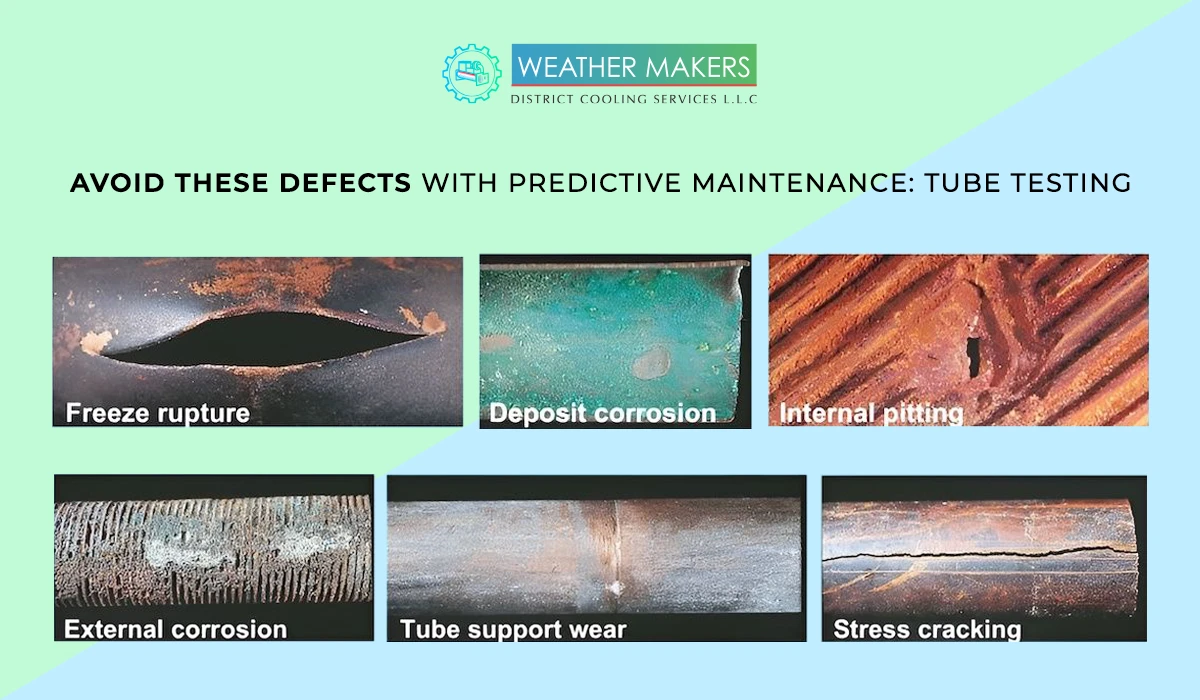
These Shell & tube heat exchangers are subjected to chemical as well as mechanical defects such as
- Corrosion due to deposits by algae, slime, or improper water treatment.
- Internal pitting brought about by aggressive elements in the water.
- Freeze ruptures from low water flow in the evaporator.
- Tube support wear, which is brought about by repeated contact between tube and support structure.
- Stress cracking, which forms as longitudinal or intergranular cracks due to high water flow.
Identification of such problems at an early stage is what would help in averting failures. And that is precisely what is facilitated by the Eddy Current tube test process.
Advantages of Eddy Current Testing of heat exchanger tubes.
Heat exchangers require little maintenance but are extremely costly to repair or replace. Keeping them in optimal condition saves both money and downtime. Regular Eddy Current testing ensures:
- Preservation of close to 90% of your HVAC equipment (primarily heat exchangers and compressors).
- Increased system and equipment dependability.
- Increased life span of equipment.
- Fewer unexpected breakdowns.
- Smooth operations with reduced downtime.
Simply stated, it is one of the best predictive maintenance practices for large chiller plants. This makes Eddy Current testing an important tool in the Predictive Maintenance of Chillers, as it helps facility managers act before failures happen rather than waiting for costly breakdowns.
Procedure for Testing Tubes Using Eddy Current
Eddy Current Technology is not new; it is decades old and was a success. Many HVAC companies were early adopters of this advanced inspection method.
1.Specialist places an inspection probe in every tube in the unit exchanger.
2.The sensor creates a magnetic field based on eddy currents.
3.The final magnetic field is monitored by a micro-processor-based memory oscilloscope.
4.If there is some such defect like corrosion, cracking, or deposits, then there is disruption in the regular circular flow of magnetic field.
5.These disruptions modify the signal on the screen such that professionals can identify and track the defect.
From time to time, tube cleaning may be necessary before testing. That is in an effort not to allow deposits or occlusions interfere with test results.
The entire process normally takes 1–2 days of downtime so it is a realistic alternative to sudden failures which might take weeks of downtime.
Extensive Reporting After an Eddy Current Test
After taking the test, results are drafted in detailed reports in typically two sections:
- Preliminary Report: Distributed on-site within minutes after testing.
- Full Report: Due in one week’s time, including:
- Full test summary.
- Tube-by-tube results.
- Examination of tubes.
- Graphic recordings of findings.
- Photographs of damaged zones.
- Expert technical recommendations.
Should the report indicate repair is necessary, technical professionals present practical repair resolutions and help you restart the chiller system. They may also recommend future routine maintenance based on the system’s configuration and operating environment.
Predictive Maintenance of Chillers with Eddy Current Testing
Compared to visual inspections or daily upkeep checks, Eddy Current testing goes in-depth and provides a scientific, fact-oriented HVAC reliability method. It doesn’t simply identify that a fault happens—it describes where precisely, what kind, and how serious a defect is.
Such a level of accuracy enables facility professionals to act prior to problems becoming serious failures. It also enables predictive maintenance approaches for sustainable cost savings in the long term with consistent system performance.
Conclusion
Eddy Current tube testing is not a routine inspection—it is a worthwhile investment in safety, performance, and longevity for your system. Preventing failures at an early stage helps safeguard your exchangers, compressors, and system from costly breakdowns. It is a quick method that is repeatable and offers detailed information beyond what routine maintenance can provide. For maximum system reliability, incorporating Eddy Current testing into your maintenance program is highly recommended. By combining Eddy Current testing with Predictive Maintenance of Chillers, businesses can achieve greater efficiency, reduce repair costs, and extend the overall lifespan of their HVAC systems.
Frequently Asked Questions
Why is an Eddy current test beneficial for system reliability?
What is Eddy Current technology in HVAC?
It is a NDT(non-destructive testing) technique in which magnetic fields are employed for determining wear or cracks or corrosion in heat exchanger tube walls.