
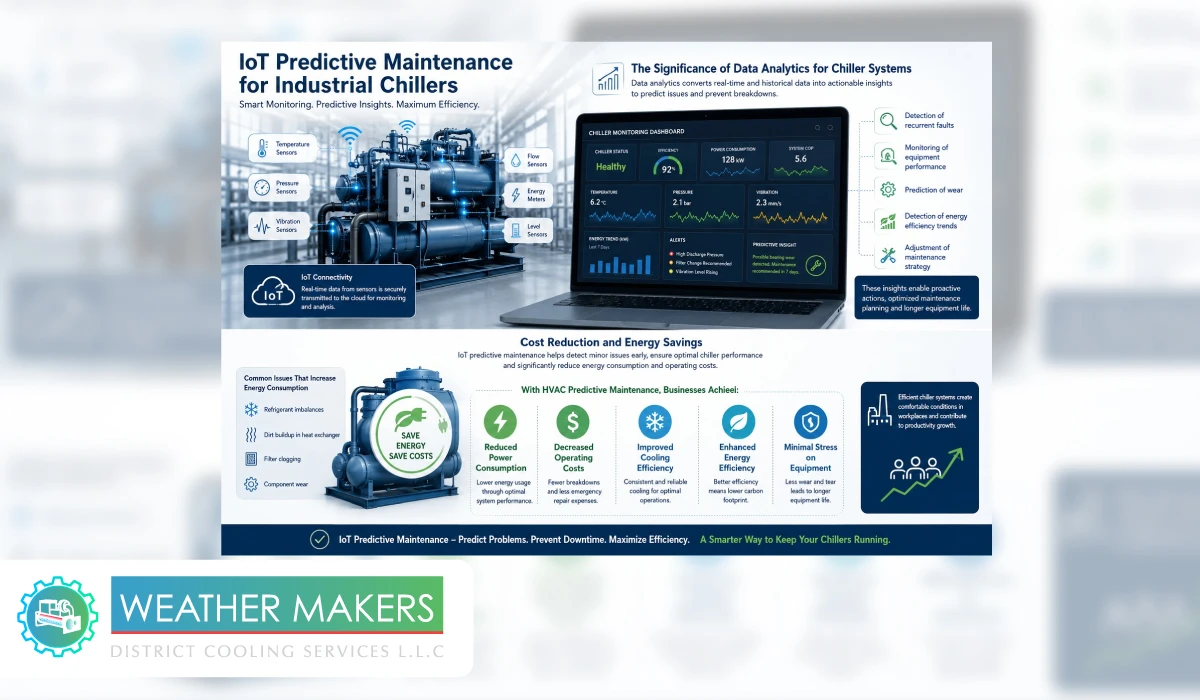
Predictive maintenance for industrial chillers allows organizations to change traditional methods of managing cooling systems. Fixed schedule maintenance or immediate repairs can cause extra downtime and higher operating costs. Modern IoT technologies provide opportunities to analyze chiller performance in real time and ensure high equipment efficiency.
Industrial chillers are used constantly in commercial and industrial settings. A small malfunction can impact not only the performance but also the energy efficiency of cooling and the durability of the equipment itself. IoT technology allows organizations to switch from emergency repairs to planned maintenance.
Today, most facilities prefer to use connected devices that deliver comprehensive performance reports and alert systems in case of any malfunction. IoT maintenance systems are faster, more accurate, and cost-efficient.
IoT Chiller Monitoring and Maintenance Explained
The Internet of Things, or IoT, represents the connection of equipment using sensors and networks. IoT technologies installed in a chiller system will continuously monitor different indicators such as temperature levels, pressure readings, compressor performance, energy efficiency, water flow rate, and vibration level.
This type of continuous performance evaluation is referred to as IoT chiller monitoring. This allows facility operators to have constant access to equipment statistics and to timely identify any problem with it.
Traditional monitoring and maintenance approaches do not provide the necessary level of visibility. IoT-based systems can address this issue.
Benefits of Predictive Maintenance of Chillers
Modern industrial cooling systems represent a big investment for businesses. Malfunctioning of this system can cause many negative consequences. Predictive maintenance allows for avoiding such situations.
While reactive approaches require waiting until equipment breaks down, predictive technologies use collected performance data to predict possible faults. Thus, maintenance engineers can address the issue before the complete failure.
Advantages of this approach include the following:
- Reduced downtime
- Reduced repair costs
- Improved energy efficiency
- Extended life of equipment
- Reliable cooling system performance
- Better operational management
Overall, a predictive strategy is much more cost-efficient and provides greater performance guarantees.
How Predictive Technology Works
Modern systems for the prediction of malfunctions are built around sensors, cloud platforms, and intelligent software. Sensors installed in the system constantly collect operational statistics.
Then the software analyzes the collected data and evaluates it against normal parameters. Any unusual changes or deviations will cause an alarm for the maintenance team.
Such issues can relate to the following problems:
- Changes in temperatures or pressures
- High vibration or energy consumption
- Imbalance in compressor performance
These signals allow maintenance technicians to respond to the problems in time. This approach will also contribute to better smart chiller maintenance and minimize the number of emergencies.
More and more facilities prefer to use remote dashboards to evaluate system performance and identify potential risks.
The Significance of Data Analytics for Chiller Systems
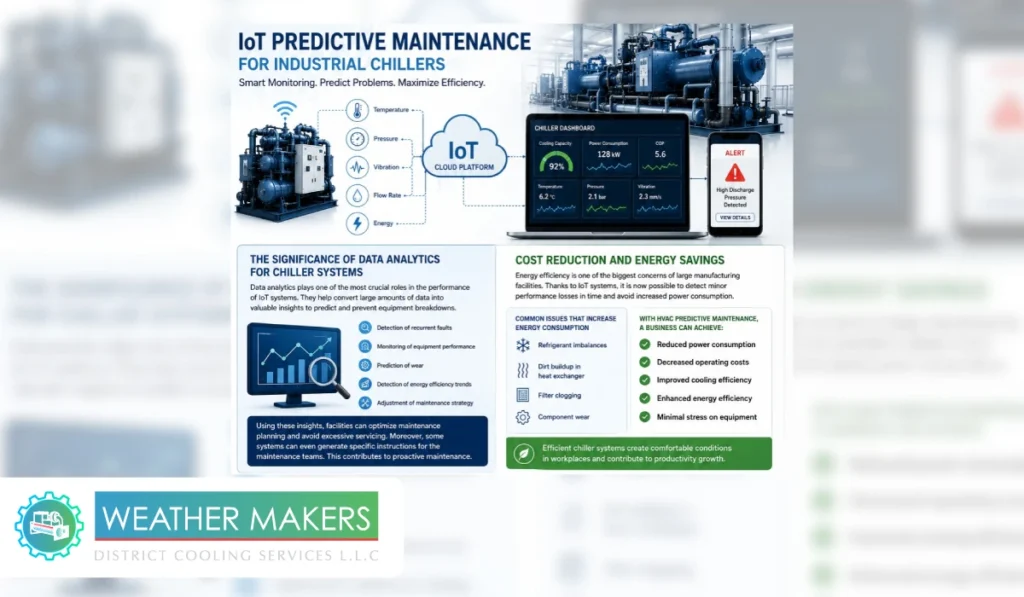
Data analytics plays one of the most crucial roles in the performance of IoT systems. They help convert large amounts of data into valuable insights to predict and prevent equipment breakdowns.
The following tasks can be performed using analytics tools:
- Detection of recurrent faults
- Monitoring of equipment performance
- Prediction of wear
- Detection of energy efficiency trends
- Adjustment of maintenance strategy
Using these insights, facilities can optimize maintenance planning and avoid excessive servicing. Moreover, some systems can even generate specific instructions for the maintenance teams. This contributes to proactive maintenance.
Cost Reduction and Energy Savings
Energy efficiency is one of the biggest concerns of large manufacturing facilities. Chillers require substantial energy to operate. Unreliable maintenance can cause increased power consumption.
Thanks to IoT systems, it is now possible to detect minor performance losses in time. Minor malfunctions such as refrigerant imbalances, dirt buildup in the heat exchanger, or filter clogging cause significant power consumption issues.
With HVAC predictive maintenance, a business can achieve the following results:
- Reduced power consumption
- Decreased operating costs
- Improved cooling efficiency
- Enhanced energy efficiency
- Minimal stress on equipment
Moreover, efficient chiller systems create comfortable conditions in workplaces and contribute to productivity growth.
Predictive Maintenance for Industrial Chillers in Large Facilities
Large facilities operate multiple chillers simultaneously. Constant monitoring of all devices becomes increasingly difficult. With predictive technologies, it becomes easier to monitor multiple systems from one screen. This contributes to optimized maintenance planning.
Some types of facilities that require efficient and reliable cooling systems include:
- Manufacturing plants
- Hospitals
- Data centers
- Hotels
- Commercial towers
- Food processing facilities
Each of these types of business relies heavily on efficient coolers. Predictive maintenance helps ensure reliable performance under all operating conditions. Moreover, with predictive maintenance, it is easier to plan the replacement of components and spare parts. This helps minimize costs.
Remote Monitoring and Instant Response
Remote monitoring and diagnostics have become essential in modern maintenance practices. IoT-based monitoring systems make it easy for technicians to examine system performance remotely.
Thanks to remote maintenance, facility managers and engineering staff can:
- Respond to alarms immediately
- Save inspection time
- Plan repair in advance
- Avoid operational interruption
Companies that look for chiller repair near me services usually give preference to those providers that offer fast diagnostic and response options.
Monitoring systems also facilitate communication between facility owners and maintenance engineers. Digital reports and performance stats can be shared via online interfaces.
Reducing the Number of Emergency Situations
Most emergencies are related to hidden issues with equipment. IoT-based predictive maintenance allows for the immediate detection of such problems.
Thus, maintenance engineers can plan a visit during downtime and perform necessary work on time. This makes the industrial chiller maintenance process more effective and cost-efficient. Preventive measures also ensure proper performance of crucial components. Such components include:
- Compressors
- Pumps
- Heat exchangers
- Control panel
- Refrigeration circuits
Replacement of these components after they break down is quite expensive. Predictive maintenance greatly minimizes such risks.
The Importance of Professional Maintenance Providers
Though technology can facilitate the process, there is no substitute for professional expertise. Competent technicians ensure smooth operation and effective maintenance of cooling systems.
Professional maintenance providers can:
- Inspect systems carefully
- Calibrate sensors properly
- Perform thorough testing
- Integrate software and hardware components
- Optimize servicing plan
- Provide emergency services
Thus, combining IoT and professional engineers makes for a perfect solution to ensure the reliable performance of cooling systems.
Integrating with Other Management Solutions
Modern industrial facilities use various solutions for the management of energy, lighting, security, or HVAC operations. IoT-based systems can be integrated easily with these solutions.
Integration of systems allows the following tasks to be performed:
- Centralized monitoring of all systems
- Optimization of energy consumption
- Automated alarms
- Generation of performance reports
- Planning of maintenance tasks
This will contribute to greater efficiency and better system performance.
Future Trends in Cooling Technologies
The future of cooling technologies belongs to IoT-based solutions and automation. Advanced artificial intelligence and machine learning are expected to appear in such systems.
In the future, IoT maintenance tools might include the following features:
- Automation of detection
- Self-adjustment
- Energy optimization
- Prediction of component wear
- Maintenance planning and recommendation
Currently, some of the best chiller maintenance companies in UAE invest in new monitoring technologies. Nowadays, facilities expect to get fast digital reports and quick technical support.
Making the Right Decision about Maintenance
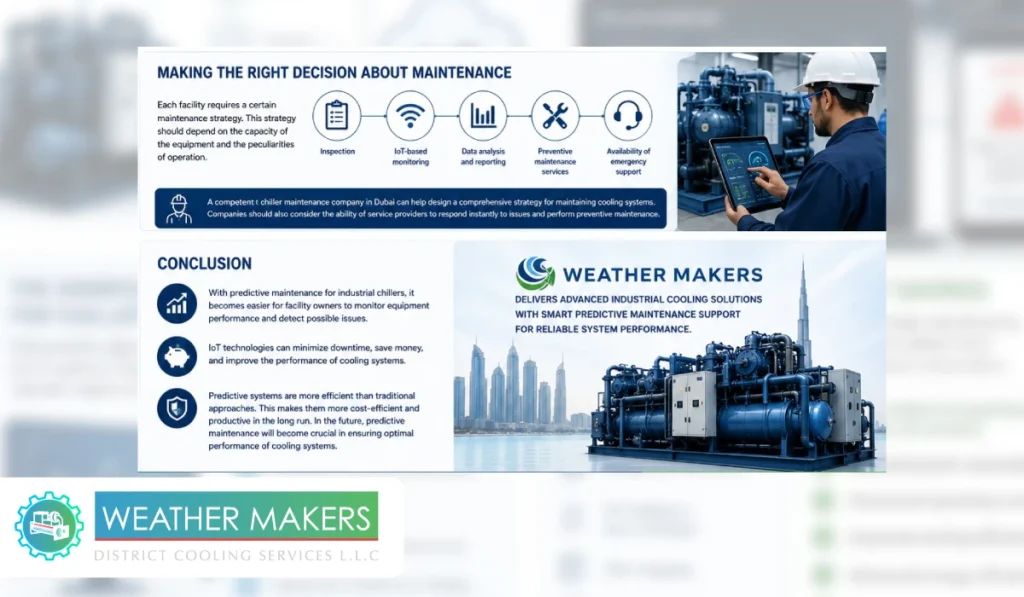
Each facility requires a certain maintenance strategy. This strategy should depend on the capacity of the equipment and the peculiarities of operation.
Effective maintenance includes the following elements:
- Inspection
- IoT-based monitoring
- Data analysis and reporting
- Preventive maintenance services
- Availability of emergency support
A competent chiller maintenance company in Dubai can help design a comprehensive strategy for maintaining cooling systems. Companies should also consider the ability of service providers to respond instantly to issues and perform preventive maintenance.
Despite that, many companies still rely on emergency repairs; nowadays, predictive approaches are gaining popularity. Even organizations in search of chiller repair in Dubai choose the services of predictive maintenance companies.
Conclusion
With predictive maintenance for industrial chillers, it becomes easier for facility owners to monitor equipment performance and detect possible issues. IoT technologies can minimize downtime, save money, and improve the performance of cooling systems.
Predictive systems are more efficient than traditional approaches. This makes them more cost-efficient and productive in the long run. In the future, predictive maintenance will become crucial in ensuring optimal performance of cooling systems.
Weather Makers delivers advanced industrial cooling solutions with smart predictive maintenance support for reliable system performance.
Frequently Asked Questions (FAQ)
What is predictive maintenance for industrial chillers?
Predictive maintenance for industrial chillers involves the collection and analysis of equipment performance data. Based on this data, it predicts possible faults and suggests preventive measures.
How does IoT contribute to chiller service?
IoT allows for monitoring systems in real time and alerts maintenance teams about any unusual performance issues.
Why is predictive maintenance more efficient than the traditional approach?
Predictive maintenance detects problems beforehand. Thus, it minimizes emergency repairs, saves power, and prolongs equipment life.



No comment